Property Investment
Invest like Roger Federer
Win just over 50% of the time … and win big. Here’s the Roger Federer lesson every investor should know.
Property Investment
6 min read


Author: Andrew Nicol
Founder, 20+ Years' Experience Investing In Property, Author & Host
Reviewed by: Ed McKnight
Resident Economist, with a GradDipEcon and over five years at Opes Partners, is a trusted contributor to NZ Property Investor, Informed Investor, Stuff, Business Desk, and OneRoof.
There’s never a “perfect” time to buy an investment property, but how does 2026 compare?
Is it a good time to buy an investment property in the 2nd half of 2026?
On the positive side buyers have plenty of choice, house prices are still below their peak, and there are signs of a future recovery.
On the other hand interest rates have gone up, costs have risen, and house prices are falling in some parts of the country.
Just keep in mind that here at Opes Partners we help investors grow their portfolios. So there is an incentive to be biased and tell you 2026 is the best time to invest.
We’re not going to do that.
Instead, this is going to be an honest analysis, based on data.
Our approach is simple, we’ll outline both sides of the argument, including the pros and cons of both sides. Then we’ll take a step back so you can make an informed decision about whether 2026 is your year to buy an investment property.
| Reasons to invest in property in 2026 | Reasons not to invest in property in 2026 |
| 1. You could be buying near the bottom of the market | 1. Property prices could fall further in some areas and the recovery could take years |
| 2. It’s a buyers’ market. There is lots of choice | 2. Interest rates have gone up |
| 3. The rental market is starting to recover | 3. Property investors’ costs have risen |
There are reasons to invest in property in 2026, but there are also reasons to wait. The right question isn’t whether 2026 is a good time to buy. It’s whether the numbers work for you.
Here are the top 3 reasons to invest in property in 2026.
New Zealand property prices are substantially cheaper than they were a few years ago.
NZ house prices peaked in November 2021. As of August 2026, they’re about 17% below that peak.
They are only slightly higher than they were at the technical bottom of the market in May 2023.
For investors that means you’re buying after a substantial drop in prices, rather than after a period of rapid growth.
Lower property prices can mean a smaller deposit, less debt, and potentially a higher rental yield.
Of course, property prices could still fall further. We’ll come to that shortly.
But if you’ve been waiting for property prices to come down before investing, they have.
The Reserve Bank currently expects prices to fall a little further, reaching a bottom around March 2027.
But from there its forecasts show house prices starting to recover.
By March 2029, the Reserve Bank forecasts house prices will be about 9% higher than at the bottom of the market.
Of course, forecasts are forecasts. There’s no guarantee house prices will follow that exact path.
Buyers have more choice when buying property.
According to realestate.co.nz there were 9.3% more properties for sale in July 2026 than at the same time last year.
That meant there were more than 35,000 properties sitting on the market for buyers to choose from.
The funny thing is, that’s not because heaps more properties are coming onto the market. There were actually 0.5% fewer new listings than last year.
Instead, properties are taking longer to sell.
REINZ says the typical property took 50 days to sell in July, two days longer than a year ago.
In simple terms, homes aren’t selling as quickly as they’re coming onto the market.
That gives buyers more properties to choose from, more time to make a decision, and more room to negotiate.
And buyers themselves have cottoned on to that. More Kiwis think it’s a good time to buy than a bad time, according to ASB’s latest Housing Confidence Survey (September 2026).
Finding a tenant started getting tougher in mid-2024. More investors reported it was harder to find a good tenant. And the median rent across the country stopped going up around the same time.
But there are early signs the rental market is starting to shift back towards landlords.
In June 2024, rental searches on Trade Me were down 13%, while new rental listings were up 14%.
Fast-forward two years and it’s almost the opposite.
Tenant searches are now up 16% year-on-year while new rental listings are up just 4%.
| Rental searches | New listings | |
| June 2024 | -13% | +14% |
| June 2025 | +2% | +11% |
| June 2026 | +16% | +4% |
Landlords are starting to notice the change too.
Tony Alexander’s June 2026 survey found a net 29% of investors said it was difficult to find a good tenant.
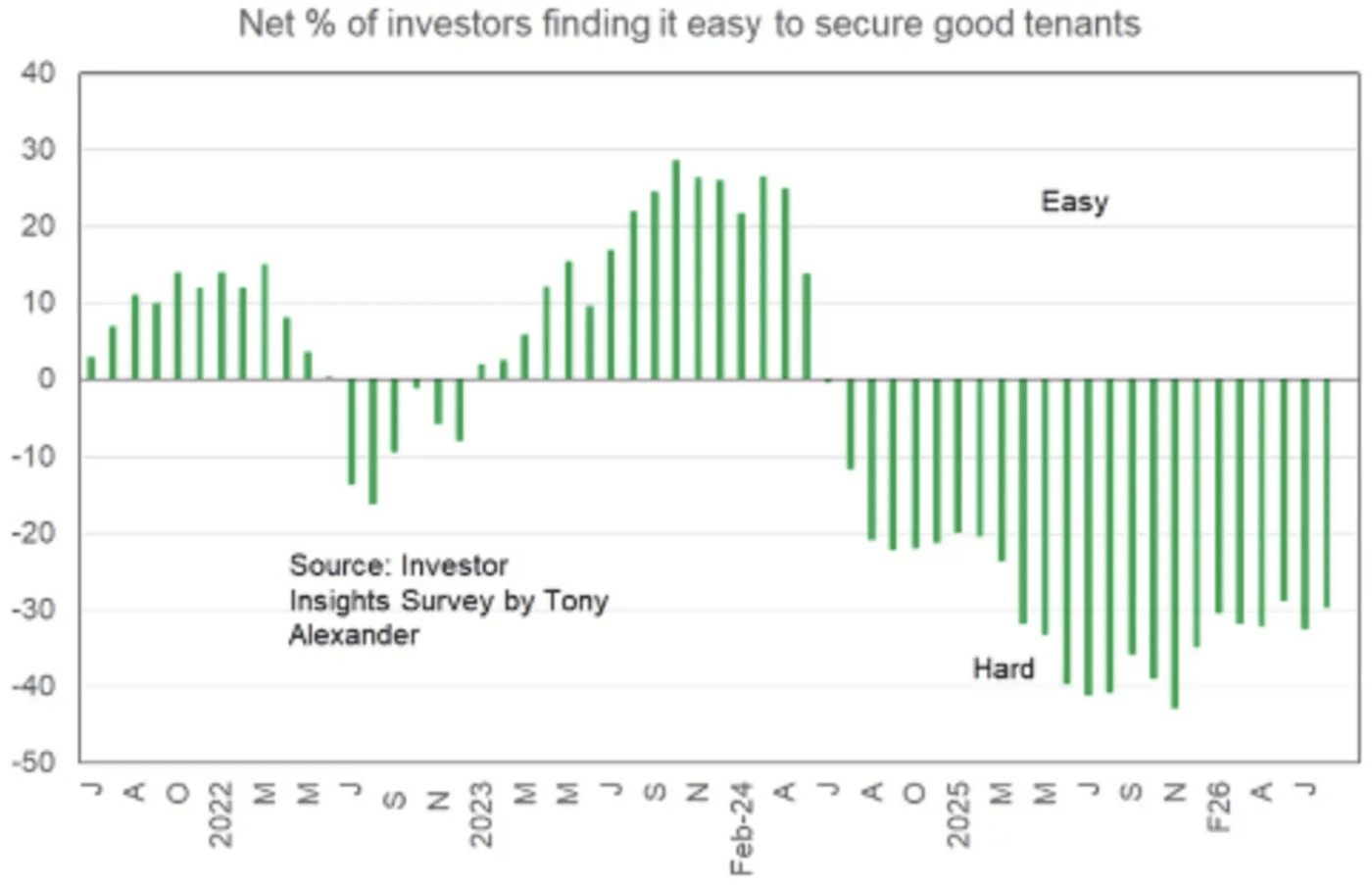
That’s still high, but it’s down from 43% in November 2025.
None of this means rents are suddenly about to take off. National rents were up just 1% over the year to June.
But tenant demand is now growing faster than the number of properties coming onto the market.
If that continues it should become easier for some investors to find tenants and could eventually put upward pressure on rents.
Now for the other side.
Because none of that means you should rush out and buy a property tomorrow.
There are still some pretty significant reasons to be cautious.
There is no guarantee NZ house prices are definitely at the bottom of the market. There is always a risk they could fall further.
Wellington City property prices fell 6.5% in the year from August 2025 – 2026.
Even if the market is near the bottom, it doesn’t mean house prices will immediately start rising.
So, if you’re buying in 2026 expecting to make a quick $100,000 in capital growth, you could be disappointed.
You may need to own the property for several years before you see substantial growth.
That’s why property generally suits a long-term investor rather than someone looking to make a quick buck.
The OCR is now 2.75%. And the Reserve Bank says it may need to increase further.
That matters because when the OCR goes up, mortgage interest rates can go up too.
For property investors it can affect you in two ways.
For starters, your mortgage gets more expensive.
Say your rental income stays the same, but your mortgage costs an extra $100 a week. That’s another $5,200 a year you need to find.
But higher interest rates can also affect house prices.
That’s because buyers generally can’t borrow as much when interest rates are higher. If buyers have less money to spend, that can take some of the heat out of house prices.
How much this affects you depends on how much you’ve borrowed.
If you’ve got a small mortgage another increase might not change much.
But if you’ve borrowed a lot … it matters a lot.
Buying the property is one thing. You also have to afford to keep it.
Council rates have risen sharply. The median rates bill across New Zealand increased 14.2% in 2024/25, followed by another 9.2% increase in 2025/26.
Put those increases together and that’s roughly a 25% increase in just two years. That’s before you factor in insurance, maintenance and mortgage costs.
The Government has proposed limiting annual rate increases to 2 - 4%. But the legislation has only passed its first reading, and the caps aren’t proposed to fully take effect until July 2029.
The truth is that some people should invest in 2026 and others probably shouldn’t.
And that’s because different investors care about different things.
If you’re buying properties with a big mortgage you’ll likely care more about interest rates. If you’re focused on cashflow, rents and rising costs matter more.
But if you’ve got the money to comfortably hold a property long term, buying around 17% below the peak could look attractive.
So don’t ask: “Is 2026 a good time to buy?” Ask: “Is 2026 a good time for me to buy?”
Because the right time to invest isn’t when the market is perfect … it’s when the numbers work for you.
Founder, 20+ Years' Experience Investing In Property, Author & Host
Andrew Nicol, Managing Director at Opes Partners, is a seasoned financial adviser and property investment expert with 20+ years of experience. With 40 investment properties, he hosts the Property Academy Podcast, co-authored 'Wealth Plan' with Ed Mcknight, and has helped 1,894 Kiwis achieve financial security through property investment.
This article is for your general information. It’s not financial advice. See here for details about our Financial Advice Provider Disclosure. So Opes isn’t telling you what to do with your own money.
We’ve made every effort to make sure the information is accurate. But we occasionally get the odd fact wrong. Make sure you do your own research or talk to a financial adviser before making any investment decisions.
You might like to use us or another financial adviser